
Zō Atelier: Modern Product System for American Mahjong
Venture: Zō Atelier LLC (Founder-Led)
Role: Founder · Product Design Lead · Experience Strategist
Core Competencies: Product Strategy, Design for Manufacturing (DFM), Industrial Design Direction, Visual Design System, Brand Architecture, Financial & Business Modeling
Tools & Tech: Figma, Adobe Creative Cloud, CAD Tooling (STEP/IGES/STL), AI-Assisted Concepting, Shopify
Target Launch & Positioning: Spring 2027 | Premium DTC Flagship (~$425 Target)

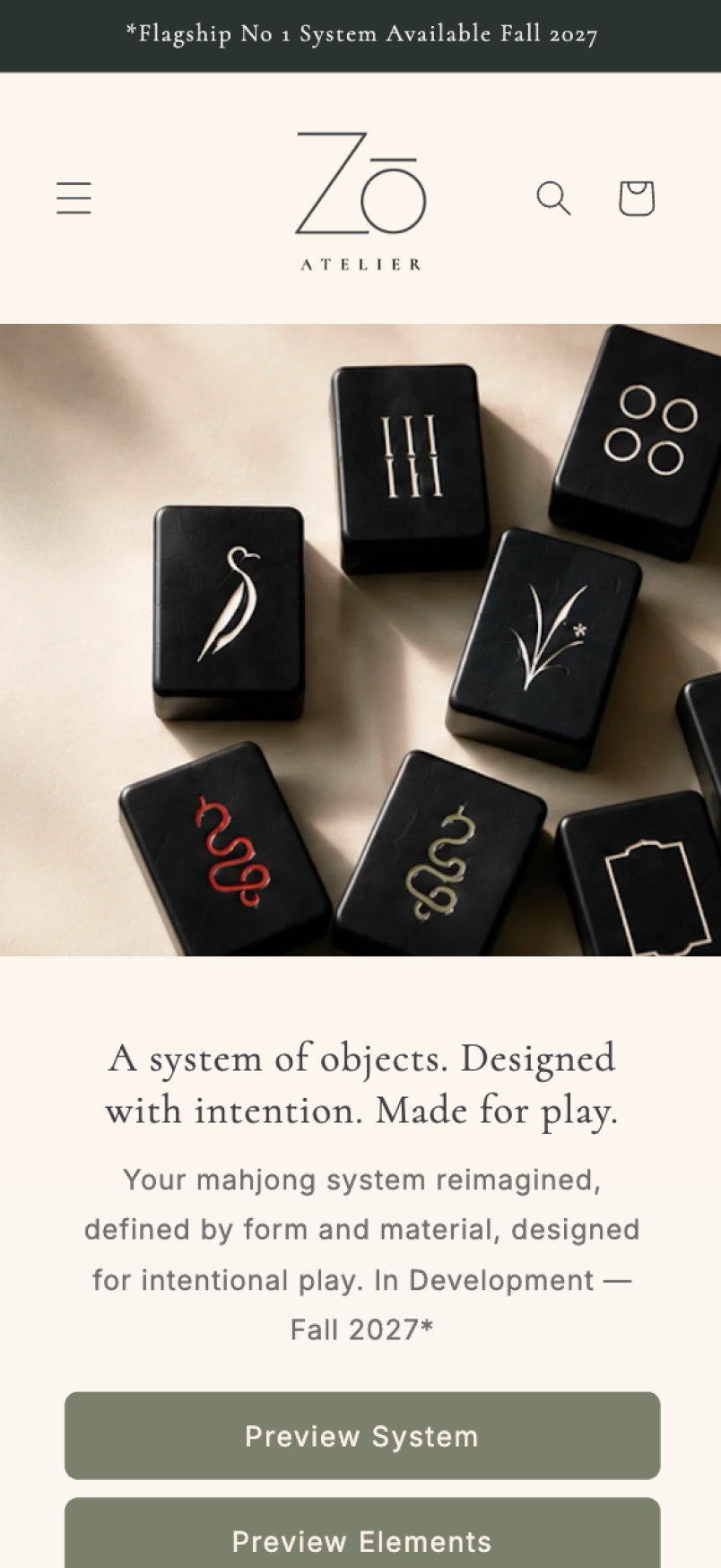
Rather than designing an isolated "tile set," I approached the initiative as an interconnected product platform capable of supporting long-term brand equity and line extensions.
Key Strategic Frameworks:
Platform Architecture: Defined a 4-tier business architecture (System [complete experience], Elements [accessories], Editions [artist collaborations], and Studio [content & culture]) to ensure scalable future SKUs.
Core Design Principles: Established 5 guiding criteria for every decision:
Recognition before decoration (usability first).
Restraint with character (form, proportion, and texture over surface graphics).
Systemic coherence (tiles, racks, dice, and packaging belong to one ecosystem).
Manufacturing reality (concepts designed to survive tooling, tolerances, and COGS).
Cultural respect (modernization without erasing game logic).
SOLUTION + EXECUTION
Pillar 1 — The Physical & Visual Tile System
Iconography & Information Hierarchy: Redesigned 144+ tiles into cohesive visual families. Reduced traditional imagery to geometric linear forms (Bams and Dots) and introduced secondary numerical indicators on Crak tiles to maintain instant recognition during fast gameplay.
Tactile & Dimensional Engineering: Defined custom tile dimensions (33mm H × 22.1mm W × 15mm D) to optimize hand feel, weight, and rack stability. Added a debossed signature Celestial Mark (0.3–0.5mm depth) on the back of each tile.
Functional Color Strategy: Implemented a restrained palette (Charcoal, Canvas, Sage) where color acts strictly as functional information rather than decorative clutter.
Pillar 2 — Design for Manufacturing (DFM) & Ecosystem
Manufacturer Specifications: Created comprehensive factory documentation specifying artwork placements, line weights, draft angles, engraving depths, material density, and surface finishes across CAD-ready files (STEP, IGES, STL).
Modular Rack Architecture: Re-engineered the traditional, awkwardly long mahjong rack into a modular assembly (magnetic / two-piece components) that fits neatly inside a compact, square packaging footprint.
Architectural Packaging Experience: Designed a rigid box and structured internal tray hierarchy that transforms unboxing into a premium design ritual.
Manufacturing Readiness: Advanced the product from speculative visual concepts to vendor-ready CAD files, material specs, and DFM documentation for supplier outreach.
Financial & Unit Economics Modeling: Established financial frameworks defining target DTC retail price points (~$425 flagship), margin requirements, COGS targets, and production run scenarios.
Business Infrastructure & IP Formation: Formed Zō Atelier LLC, secured EIN, initiated trademark filings, structured copyright protections for original tile artwork, and executed vendor NDAs.
Brand System Scalability: Built a design system that successfully extends across tiles, mats, dice, draw bags, packaging, digital storefronts, and future artist editions.
Simplicity is an Information Architecture Problem: Removing visual elements is easy; knowing which elements to retain to preserve user recognition requires deep research and usability discipline.
Physical Constraints Drive Better Product Strategy: Packaging dimensions forced modular rack innovation; engraving tolerances refined the iconography. Constraints clarify what is truly essential.
Product Leadership Unifies Disciplines: Success required bridging market insight, industrial design, manufacturing reality, supply chain economics, and brand strategy into a single coherent system.
EXECUTIVE SUMMARY
Zō Atelier is a founder-led product venture exploring how American mahjong can be reimagined for a design-conscious audience without compromising the game’s deep cultural history or fast-paced playability. Operating at the intersection of systems thinking, industrial design, and business strategy, I led the project from initial market opportunity through visual identity, physical component architecture, design for manufacturing (DFM), packaging, and commercialization planning.
THE CHALLENGE
The Market Opportunity
While American mahjong is experiencing rapid growth, the market is overwhelmingly saturated with highly decorative, colorful aesthetics. For consumers who value architectural restraint, modern interiors, and timeless materials, there were virtually no alternatives.
This revealed a larger product question:
Could a mahjong set function simultaneously as a highly functional game system and a premium design object worthy of display?
The Friction Points
Cognitive Recognition vs. Visual Reduction: Experienced players scan dozens of tiles in milliseconds. Over-simplifying traditional iconography (Bams, Craks, Dots, Winds, Dragons) risks causing game friction.
Manufacturing & Business Constraints: Transitioning from digital concepts to physical production required balancing material density, engraving tolerances, COGS targets, modular packaging footprints, and component sourcing.